The short answer
Two choices decide everything with apples. First, the rootstock sets the tree's final size, not the variety, so choose it to fit your space: a dwarfing M9 or M26 for a small garden, the common MM106 where you have more room. Second, most apples need a pollination partner of a different variety flowering at the same time nearby, unless you pick a self-fertile one like 'Falstaff'. Plant bare-root trees in winter, water them for the first couple of years, prune lightly each winter, and pick from late summer into autumn.
Apples at a glance
Apples are the easiest tree fruit to grow in the UK and crop for decades once established. Get the rootstock and pollination right at the start and the rest is light work: a little pruning each winter and a harvest from late summer on.
| Apples | |
|---|---|
| Plant | Bare-root in the dormant season, roughly November to March; container-grown any time |
| Position | Full sun, sheltered from strong wind, in well-drained soil |
| Size set by | The rootstock, not the variety (see rootstock table) |
| Pollination | Most need a compatible partner nearby; some are self-fertile |
| Prune | Free-standing trees in winter, November to early March |
| Harvest | August for the earliest, most September to October |
Choosing a rootstock
Here is the thing most people get wrong. The rootstock, not the variety, controls how big the tree ends up. The same 'Sunset' apple can be a waist-high stepover or a 4m tree depending on what it is grafted onto. So I always pick the rootstock first, because it is the one thing you cannot change later, then choose the variety second.
| Rootstock | Vigour | Approx height | Suits |
|---|---|---|---|
| M27 | Extremely dwarfing | 1.2 to 1.8m (4 to 6ft) | Very small gardens, stepovers, dwarf pyramids; needs permanent staking |
| M9 | Dwarfing | 1.8 to 2.4m (6 to 8ft) | Small gardens, cordons and trained forms; needs permanent staking |
| M26 | Dwarfing | 2.4 to 3m (8 to 10ft) | Bushes, cordons and large containers; needs permanent staking |
| MM106 | Semi-vigorous | 3 to 4m (10 to 13ft) | The most common garden rootstock; most forms, but too big for a tiny plot |
| MM111 | Vigorous | 4 to 4.5m (13 to 15ft) | Half-standards and standards on poorer soil |
| M25 | Very vigorous | 4.5m (15ft) or more | Full standards and traditional orchards; too big for most gardens |
For most gardens I would reach for M26 or M9 if space is tight or you want a cordon, and the semi-vigorous MM106 if you have room for a proper tree. The dwarfing stocks need permanent staking, because they never make enough root to hold themselves up. Save MM111 and M25 for half-standards and old-style orchards.
Pollination
Most apples need a compatible partner of a different variety flowering at a similar time nearby to crop well. The RHS sorts varieties into numbered pollination groups by flowering time: pick a partner from the same group or an adjoining one. Triploid varieties (marked T), such as 'Bramley's Seedling', are poor pollinators and need two other varieties nearby. A few are self-fertile or partly so, for example 'Falstaff' (self-fertile) and 'Laxton's Fortune' (partly self-fertile).
In practice you rarely need to plant two trees yourself. Apples and crab apples are common enough that a neighbour's tree a garden or two away will usually do the job, as long as it flowers at a similar time. If you are not sure, or you only have room for one tree, a self-fertile variety takes the worry out of it.
Planting
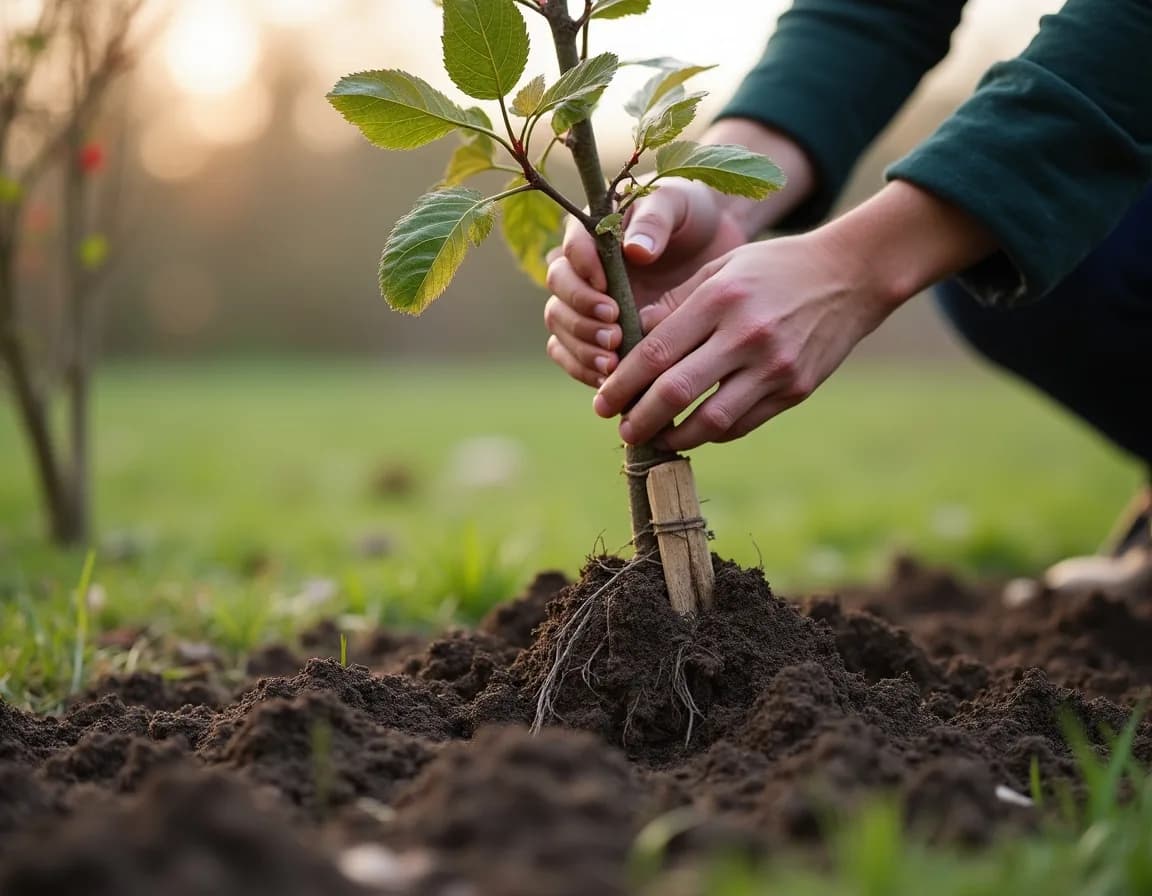
Buy apples as bare-root trees and plant them roughly November to March, while they are dormant and leafless. They are cheaper than potted trees, establish better, and this is when the widest choice of varieties and rootstocks is on sale. Container-grown trees can go in at any time of year, but they cost more and the range is narrower.
- Choose a sunny, sheltered spot in well-drained soil. Apples flower in spring, so avoid frost pockets that can kill the blossom.
- Soak the roots of a bare-root tree in a bucket of water for about half an hour before planting. If you are planting into a lawn, clear a circle of grass at least 1m (3ft) across first so the young tree is not competing with turf.
- Set the tree so the graft union, the bulge low on the stem, sits just above soil level. Planting it too deep lets the variety root and cancels out the rootstock's dwarfing effect.
- Stake it. Dwarfing rootstocks need a permanent stake for life; others need one for the first few years while the roots take hold.
Water newly planted trees regularly through their first couple of summers. After that a tree in the ground rarely needs watering, though an apple in a pot does: keep the compost evenly moist and feed it with a high-potassium liquid feed every fortnight in the growing season.
Pruning
Free-standing apple trees are pruned in winter, November to early March, while the tree is dormant. The goal is an open-centred, goblet shape with well-spaced main branches, so light and air reach the fruit. It is a gentle job: routine winter pruning takes out only about 10 to 20 per cent of the canopy, so resist the urge to hack.
Each winter, work through three steps:
- First, cut out any dead, diseased, damaged or crossing shoots.
- Then thin the strong shoots growing into the centre of the tree, leaving the weaker ones to fruit.
- Finally, shorten the previous year's growth on each main branch by a quarter to a third, cutting just above an outward-facing bud to steer new growth outwards.
One important exception. Spur-bearers such as 'Cox's Orange Pippin', 'Sunset' and 'James Grieve' carry fruit on short stubby spurs, so you can shorten shoots freely and simply thin crowded spurs. Tip-bearers and partial tip-bearers such as 'Discovery', 'Bramley's Seedling' and 'Blenheim Orange' fruit at the very tips of last year's shoots, so shortening those tips cuts off the crop: leave the young shoots alone and reduce a proportion of older branches instead. For trained forms like cordons and espaliers, and for the detail of shaping a tree over its life, see caring for a fruit tree.
Harvesting and storing
The earliest varieties ripen from August, but most apples are ready through September and October. An apple is ripe when it has swelled and coloured and comes away easily: cup it in your hand, lift and give a gentle twist, and a ripe one parts from the tree with the stalk still on. If you have to tug, leave it a little longer.
Early dessert apples are best eaten within days and do not keep. Late varieties store for weeks or months: pick them unbruised, wrap or lay them in trays so they are not touching, and keep them somewhere cool, dark and frost-free. Check them over now and then and use any that are starting to soften.
Varieties to try
These all hold an RHS Award of Garden Merit, so they are reliable in UK gardens. I have flagged the self-fertile ones, which are the easiest choice if you only have room for a single tree:
| Variety | Notes |
|---|---|
| 'Discovery' AGM | Early dessert; crisp, early-ripening, partial tip-bearer |
| 'James Grieve' AGM | Early dessert; juicy and reliable, a good pollinator |
| 'Egremont Russet' AGM | Mid-season dessert; nutty russet, self-fertile enough to crop alone |
| 'Sunset' AGM | Mid-season dessert; a compact, easy Cox type for smaller gardens |
| 'Falstaff' AGM | Mid to late dessert; self-fertile, so good as a single tree |
| 'Grenadier' AGM | Early cooker; cooks to a puree, crops heavily |
| 'Bramley's Seedling' AGM | Classic cooker; triploid, so needs two other varieties nearby |
Apples are the backbone of a home fruit garden: see growing fruit in the UK for how they fit alongside soft fruit like raspberries and strawberries.
Frequently asked questions
How big will my apple tree get?
That depends on the rootstock, not the variety. A dwarfing M9 or M26 stays around 2 to 3m, the common semi-vigorous MM106 reaches 3 to 4m, and vigorous MM111 and M25 make large standards of 4.5m or more. Choose the rootstock to fit your space, because it is the one thing you cannot change once the tree is planted.
Do I need two apple trees to get fruit?
Most apples need a compatible partner of a different variety flowering at a similar time nearby, but you rarely have to plant both yourself: a neighbour's apple or crab apple a garden or two away usually does the job. If you only have room for one tree, choose a self-fertile variety such as 'Falstaff' or 'Egremont Russet'.
When should I plant an apple tree?
Plant bare-root trees in the dormant season, roughly November to March, when they are leafless. Bare-root trees are cheaper, establish better and offer the widest choice of varieties and rootstocks. Container-grown trees can be planted at any time of year if you miss the window. Set the graft union just above soil level and stake the tree.
When and how do I prune an apple tree?
Prune free-standing apple trees in winter, November to early March, while they are dormant. Remove only about 10 to 20 per cent of the canopy: take out dead, diseased and crossing wood, thin strong shoots growing into the centre, then shorten last year's growth on the main branches by a quarter to a third. Spur-bearers can be cut back freely; tip-bearers fruit at the shoot tips, so leave those young shoots alone.
When are apples ready to pick?
Early varieties ripen from August, but most apples are ready through September and October. An apple is ripe when it has swelled and coloured and lifts away with a gentle twist, stalk still attached. If you have to pull hard, leave it longer. Eat early apples within days; store late keepers somewhere cool, dark and frost-free.
How we checked this3 sourcesView sourcesHide
Our guides draw on expert bodies like the RHS and Garden Organic, plus experienced growers, read at source. We check every guide against those sources on the date shown, and where advice differs between them, we say so. Garden Plans is published by Limely.
- AuthorityHow to grow apples, Royal Horticultural Society. Checked 26 Oct 2026.
- AuthorityApples and pears: winter pruning, Royal Horticultural Society. Checked 26 Oct 2026.
- AuthorityHow to grow apples, Gardeners' World. Checked 26 Oct 2026.