The short answer
Get the timing right and the rest is easy. Prune apples and pears in winter while they are dormant, but prune plums, cherries and other stone fruit in summer, never winter, or you let in silver leaf disease. Feed with a potassium-rich fertiliser in late winter, mulch in spring and autumn, water young trees through dry spells, and thin a heavy crop in early summer for bigger, better fruit. For apple-specific detail, see our guide to growing apples.
What does caring for a fruit tree actually involve?
An established fruit tree asks for very little, and most of what it does need happens at a set time of year. Across a season the jobs are: prune to keep the shape open and productive, feed and mulch to keep it fed and the roots cool and moist, water it while it is young, and thin the fruit if it sets more than it can carry. Do those few things at the right moment and a healthy tree will crop for decades.
The one job people get wrong is timing the pruning. Apples and pears are pruned in the dormant winter, but plums, cherries and every other stone fruit are pruned in summer, and the difference is not a preference: it decides whether a serious disease gets in. That is the first thing to fix, so it is the next section.
When to prune, by fruit type
Different fruit trees are pruned at opposite ends of the year. The short version: apples and pears in winter, stone fruit in summer. Here is each type, when to cut and why.
| Fruit type | When to prune | Why |
|---|---|---|
| Apples and pears | Winter, while dormant (November to early March) | They fruit best on an open crown and heal well in the dormant season, when you can see the branch framework with the leaves off. |
| Plums and gages | Summer for established trees (around July); early spring (around April) for young trees | Pruning in winter lets in silver leaf disease, to which plums and other Prunus are prone. Summer cuts heal fast and stay clean. |
| Cherries | Summer, in active growth (roughly May to August) | A stone fruit like the plum, so the same silver leaf and bacterial canker risk rules out winter pruning. |
| Other stone fruit (peaches, apricots, damsons) | Spring and summer, never winter | All Prunus species are vulnerable to silver leaf; prune only when the tree is in growth and can seal the wound. |
How do I prune an apple or pear?
Prune apples and pears while the tree is dormant, after leaf fall and before growth starts again, usually between November and early March. The aim is an open-centred, goblet-shaped crown with well-spaced main branches, so light and air reach the fruit. Work through the cuts in this order:
- Take out all dead, diseased and damaged wood first.
- Remove crossing shoots that rub, and any strong shoots growing in towards the centre of the tree.
- Shorten or remove low branches that droop downwards and sit in poor light.
- On spur-bearing varieties, thin out overcrowded fruiting spurs. On tip-bearers, go lightly, as most of the fruit sits at the shoot tips and hard pruning removes next year's crop.
Keep routine winter pruning to about 10 to 20 per cent of the canopy. Cut harder than that and the tree answers with a thicket of vigorous upright watershoots the following summer. Apple and pear specifics, including spur and tip bearers, are in our guide to growing apples.
Formative pruning versus maintenance pruning
There are two jobs hiding in the word "pruning", and knowing which one you are doing stops you butchering a young tree or neglecting an old one.
- Formative pruning builds the shape. It runs for roughly the first three to four years after planting and is about creating a strong, balanced branch framework. It is harder and more structural, because you are deciding where the tree's main limbs will be for life.
- Maintenance (renewal) pruning keeps an established tree in that shape. From about year four it is a lighter, yearly tidy: take out the dead, crossing and crowded wood, and renew a little old fruiting wood so young, productive growth keeps coming. You are editing, not rebuilding.
Plums follow the same idea on a summer timetable: a light formative shape on a young tree in early spring, then a summer tidy once it is established.
How do I feed, mulch and water a fruit tree?
Feed in late winter, before the growing season starts, with a potassium-rich general fertiliser. Fruit trees need plenty of potassium (potash) for buds and fruit, so a rose feed works well. Then mulch to lock moisture in and feed the soil, and water while the tree is still getting its roots down.
| Feeding, mulching and watering | |
|---|---|
| When to feed | Late winter to early spring, before the growing season starts |
| What to feed | A potassium-rich general fertiliser (a rose feed is fine); fruit trees need high potassium for buds and fruit |
| Feeding rate (Growmore) | About 100g per sq m (3oz per sq yd) for dessert apples in bare soil, 140g per sq m (4oz per sq yd) in grass and for established pears, cherries and plums; cooking apples get roughly 50% more nitrogen |
| When to mulch | Mid-to-late spring and again in autumn |
| Mulch depth and type | 7.5 to 10cm (3 to 4in) of well-rotted manure, garden compost, leafmould or straw |
| Mulch gap at the trunk | Keep a mulch-free circle of 7.5 to 10cm (3 to 4in) around the trunk so the bark does not rot |
| Watering | Water newly planted trees in dry spells for the first couple of years, at the base; established trees in the ground rarely need it |
Newly planted trees are the exception on watering: give them a good soak in any dry spell for the first couple of years, at the base so it reaches the roots. A young tree should also be staked at planting and kept staked for the first two or three years while the roots anchor, then freed so the trunk can flex and thicken.
Should I thin the fruit, and when?
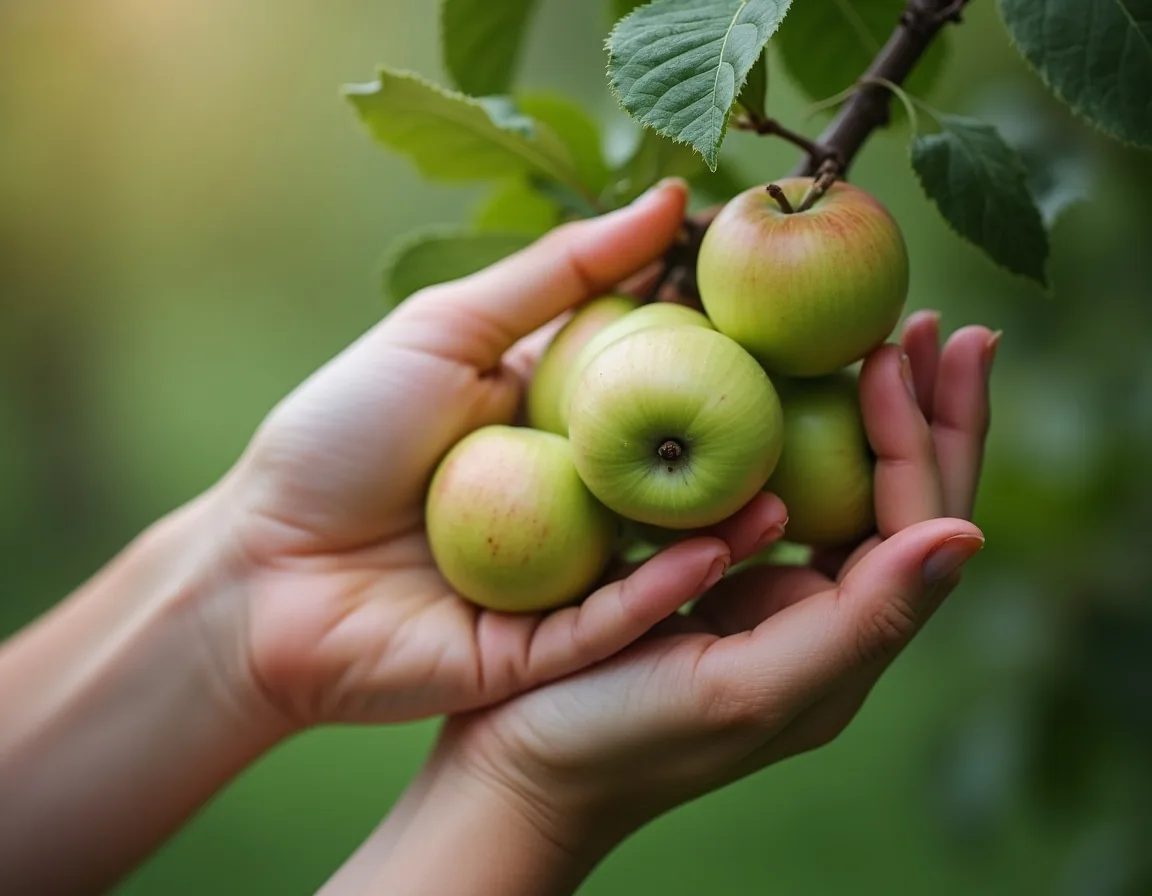
Often, yes. A tree that sets more fruit than it can carry gives you a lot of small fruit, risks snapping a branch, and can drop into biennial bearing (a heavy year, then a bare one). Thinning fixes all three.
Many fruit trees shed a flush of immature fruitlets in early summer on their own. This is the June drop, it is completely normal, and it is not a problem. Let the tree finish its June drop first, then thin by hand in early summer, finishing by mid-July.
| Fruit thinning | |
|---|---|
| When | Early summer, straight after the June drop; finish by mid-July |
| Why | Bigger, better fruit, no branches breaking under the load, and no biennial bearing (a heavy year then a bare one) |
| Dessert apples | One or two fruits every 10 to 15cm (4 to 6in) |
| Cooking apples | One fruit every 15 to 23cm (6 to 9in) |
| Plums | One fruit every 5 to 8cm (2 to 3in), or a pair every 15cm (6in) |
| Pears | Thin clusters to two fruits, 10 to 15cm (4 to 6in) apart |
Once the fruit is thinned and the tree is cropping, the season's care is basically done. For a wider view of what grows well and where fruit fits in a UK plot, see growing fruit in the UK.
Frequently asked questions
When should I prune my fruit tree?
It depends on the type. Prune apples and pears in winter, while they are dormant, usually between November and early March. Prune plums, cherries and other stone fruit in summer when they are in active growth, never in winter, because winter cuts let in silver leaf disease and bacterial canker.
Why can't I prune a plum or cherry tree in winter?
Plums, cherries and other stone fruit are Prunus species, which are prone to silver leaf disease. The fungus gets in through fresh pruning cuts and spreads fastest in the cold, damp dormant season. Pruning in spring and summer, when the tree is growing and wounds seal quickly, avoids it. Silver leaf can kill the tree, so the timing matters.
How and when should I feed a fruit tree?
Feed in late winter or early spring, before the growing season, with a potassium-rich general fertiliser such as a rose feed, because fruit trees need high potassium for buds and fruit. A tree growing in soil you mulch every year often needs no extra feed at all.
What is the June drop and should I worry about it?
The June drop is when apples, pears, plums and cherries naturally shed some of their immature fruitlets in early summer. It looks alarming but it is normal and not usually a cause for concern, as a good crop is generally left on the tree. Wait until it has finished before you thin any fruit by hand.
Do I need to thin the fruit on my tree?
Often yes, especially on plums and apples that have set heavily. Thin in early summer after the June drop, finishing by mid-July. Aim for one or two dessert apples every 10 to 15cm, one cooking apple every 15 to 23cm, and one plum every 5 to 8cm. Thinning gives bigger fruit, stops branches breaking and avoids a bare year next season.
How we checked this3 sourcesView sourcesHide
Our guides draw on expert bodies like the RHS and Garden Organic, plus experienced growers, read at source. We check every guide against those sources on the date shown, and where advice differs between them, we say so. Garden Plans is published by Limely.
- AuthorityApples and pears: winter pruning, Royal Horticultural Society. Checked 26 Oct 2026.
- AuthorityPlums: pruning, Royal Horticultural Society. Checked 26 Oct 2026.
- AuthorityPruning fruit trees in summer, Gardeners' World. Checked 26 Oct 2026.